
Ever brined something and ended up with meat that tasted like the sea? Equilibrium brining stops that for good. You weigh the meat, the calculator works out the salt, and however long it sits it can’t end up saltier than you set it.
| Wet brine (with 1 litre of water) | 30 g salt |
|---|---|
| Dry brine | 12.5 g salt |
In this guide I’ll walk you through the simple steps: what equilibrium brining is, wet, dry or cure, which salt to use, and the science behind it all. It’s so easy once you’ve tried it!
What equilibrium brining is
Equilibrium brining is salting by weight. You weigh the meat (and the water too, for a wet brine) and add salt as a percentage of that total.
Then you wait. The salt spreads out until the meat and the water are exactly as salty as each other, and there it stops. That’s the equilibrium.
For a whole chicken in a wet brine, the calculator starts you at 1.5%. If you like it a touch saltier or milder, you can move it anywhere from 1.2% to 1.8%.
Why it can’t over-salt
A traditional brine is far saltier than you’d ever want the meat to be. It works, but it’s a race against the clock. Leave the meat in too long and it just keeps taking on salt.
With equilibrium there’s only so much salt in the bag.
Say you’ve got a 2 Kg chicken in 2 litres of water. At 1.5% that’s 60 g of salt. At the start it’s all in the water, so the water is at about 3%. Over the next day or two the salt moves into the chicken until the meat and the water are both at 1.5%. Then it stops. There’s no more salt to go in.
So a little longer does no harm. If dinner moves to tomorrow, the chicken will wait.
That doesn’t mean longer is better though. Give it the time the calculator shows and get it out.
And a dry brine is simpler still. The salt you rub on is all the salt there is.
Wet, dry or cure
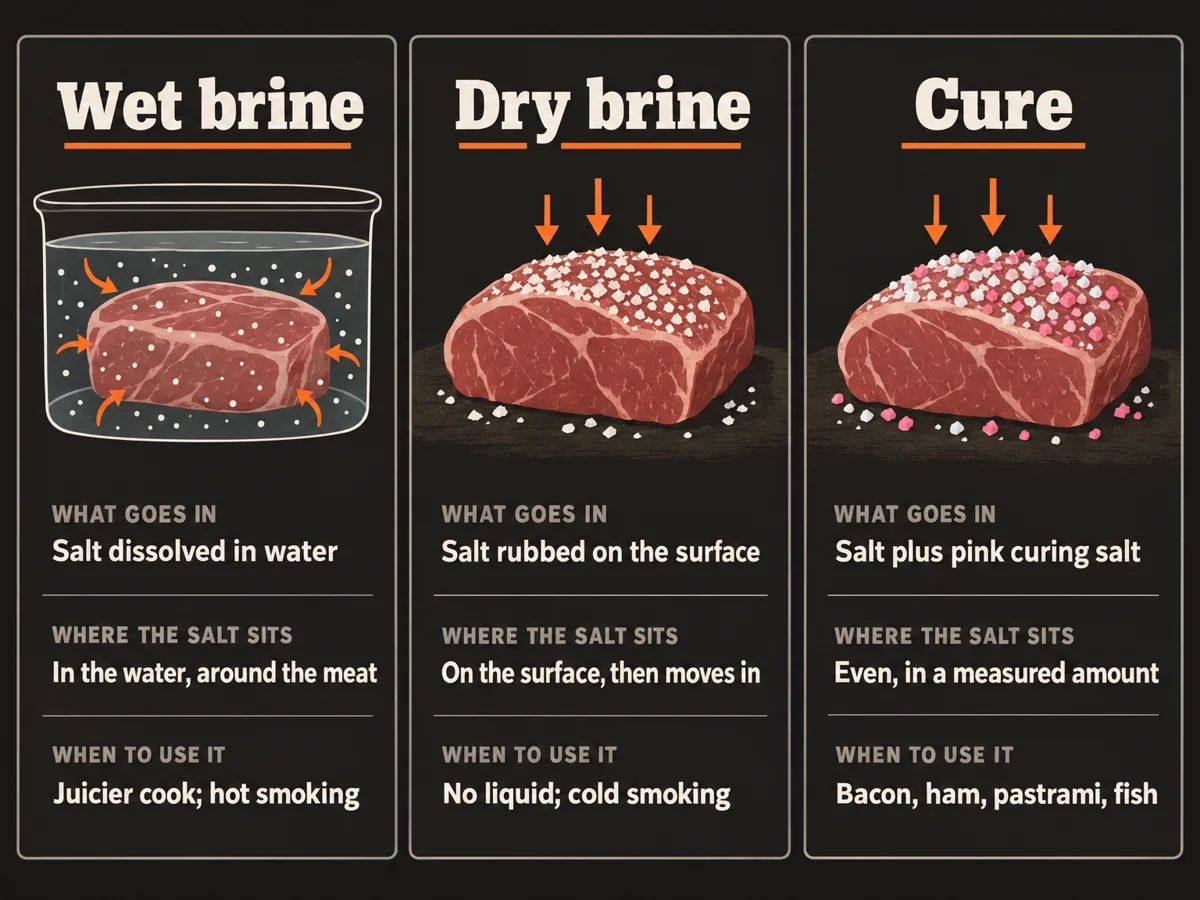
There are three ways to do this, and the calculator does all of them.
Wet brine
The meat sits in salted water in a bag or a box. The salt is worked out on the meat and the water together.
It suits whole chicken and chicken pieces, turkey, pork loin or chops and pork shoulder, all at 1.5%. Sugar is optional for chicken. The trade-off is room: a whole bird in a box of water takes up a fair bit of fridge.
Dry brine
Salt straight on the meat, no water, worked out on the weight of the meat only. You can dry brine whole chicken and chicken pieces, turkey, duck legs for confit, pork loin and chops, pork shoulder, brisket, ribs and fish.
Any salt in your rub counts towards the total. So with a salty rub, use less salt or swap to a salt-free rub.
As for juiciness, wet wins, but not by much. In one home test a wet-brined chicken breast came out only slightly juicier than a dry-brined one. By all means try out both methods and see what you think.
Cure
A cure is a dry or wet brine with curing salt added. It’s what turns pork belly into bacon.
It’s for anything that’s cooked or smoked before you eat it, and the curing salt is what keeps the meat safe through a long cure or a low, slow smoke. The menu covers bacon (back, streaky or middle), pancetta and lardons, guanciale, Kassler, ham or gammon, pastrami and salt beef, jerky, duck breast and traditional smoked salmon, and biltong. Biltong’s the exception: it’s eaten raw, and salt, vinegar and drying keep it safe, so its curing salt starts off. Gravlax is on there too, without curing salt.
Bacon is set at 2% salt (that includes the salt in the curing salt) and 1% sugar. That’s the mild, modern end. If you like it saltier, pick Traditional dry cure on the menu (2.5%). Proper old-fashioned dry-cured bacon and pancetta go to 3% and more, and there’s a lot more on that in my Ultimate Curing Guide, which is on its way.
The curing salt is worked out from the weight of the meat, at 120 ppm of nitrite. That’s parts per million: 120 mg in every Kg. For a 1 Kg piece of belly in a dry cure, it comes to 1.9 g of Prague Powder #1.
Under 2 g!
That’s why you need scales that read to 0.1 g for this. Kitchen scales that go up in whole grams aren’t fine enough.
I’ve set every cure to 120 ppm, and you can’t change it. It’s the level US law sets for bacon, and it’s at or under the limit for cured meat sold in the UK, the EU, Australia and New Zealand. In the UK those rules don’t cover what you cure at home, but I’d rather stay inside them anyway.
Curing salt, the short version
- Use Prague Powder #1 (Cure #1), or a ready-mixed nitrite salt with its % on the label. The calculator takes both.
- Not Prague Powder #2, saltpetre, Tender Quick, celery powder, celery salt or pink Himalayan salt. They’re different things, and the calculator won’t take them.
- Plain salt means salt with nothing curing in it. If the bag says nitrite, curing salt, Pökelsalz or Tender Quick, it isn’t plain salt. Never add Cure #1 on top.
- Weigh it on scales that read to 0.1 g. Never use a spoon.
- Keep curing salt in its own labelled tub, well away from your salt. Prague Powder #1’s pink can fade, so check the label says sodium nitrite, 6.25%.
- Too much is harmful and too little won’t protect the meat, so stick to the amount the calculator gives you.
- Keep curing meat in the fridge at 5°C/41°F or colder.
Which curing salt is which, and why, is all going in the curing guide. If you’re not sure in the meantime, give me a shout.
Step by step
Here’s a wet brine for a whole chicken, start to finish. A dry brine is the same, minus the water.
Weigh the meat
Put the chicken on the scales and type the weight into the calculator, in grams. Any digital kitchen scales will do here. Say it’s 2 Kg: type 2000.
Measure the water
Measure out cold water, enough to cover the chicken in the bag. The calculator takes it in ml, and 1 ml of water weighs 1 g, so a jug or the scales both work. Say it’s 2 litres: type 2000.
It doesn’t matter how much water you use. Whatever you put in, the calculator works the salt out from it.
Weigh the salt
The calculator gives you the salt in grams: 60 g for this one. Weigh it. A spoonful of one salt can weigh more than twice a spoonful of another (more on that below).
Mix
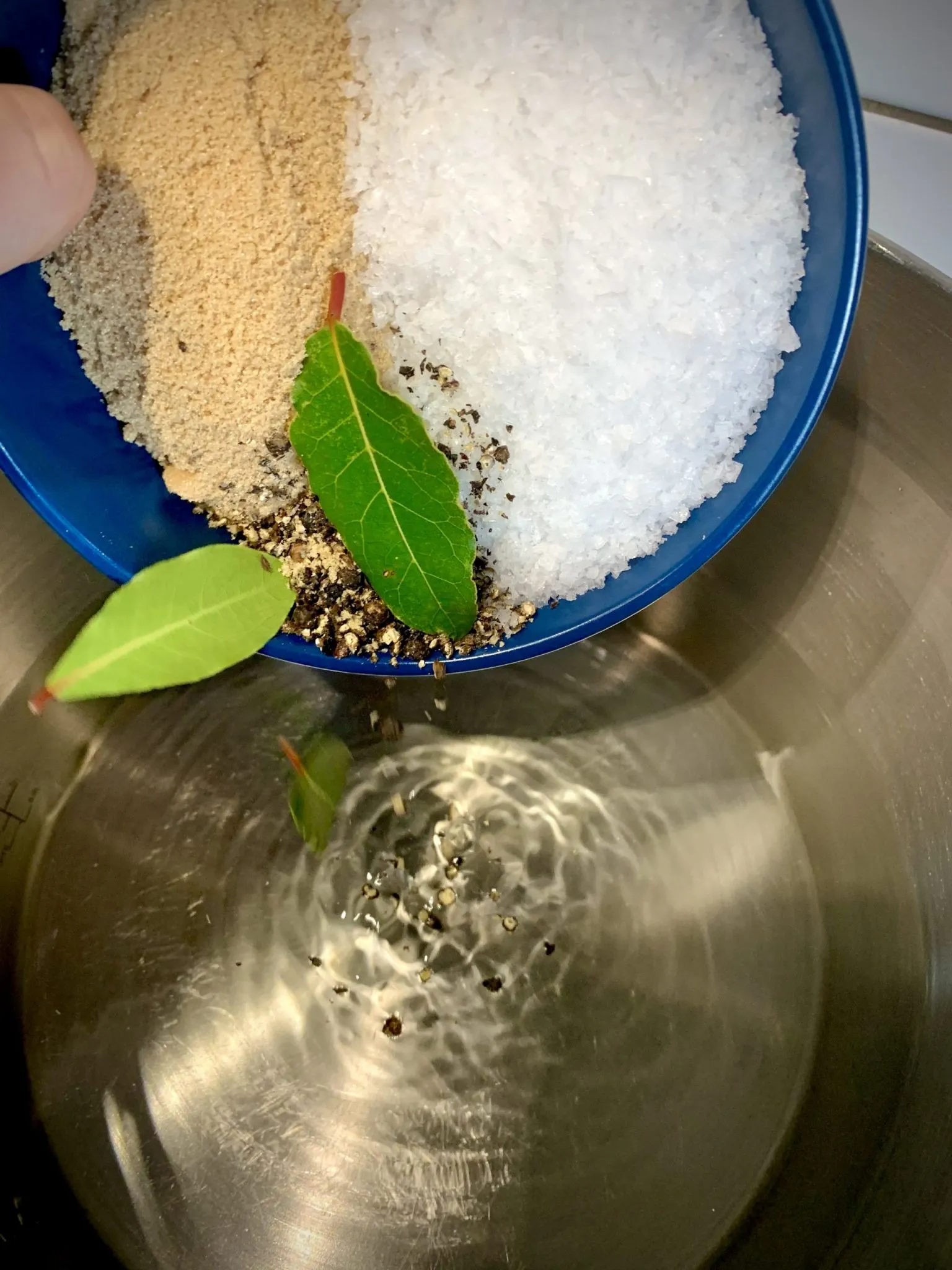
Stir the salt into the water until it’s all dissolved. If you’re adding sugar, it goes in now too.
Bag it
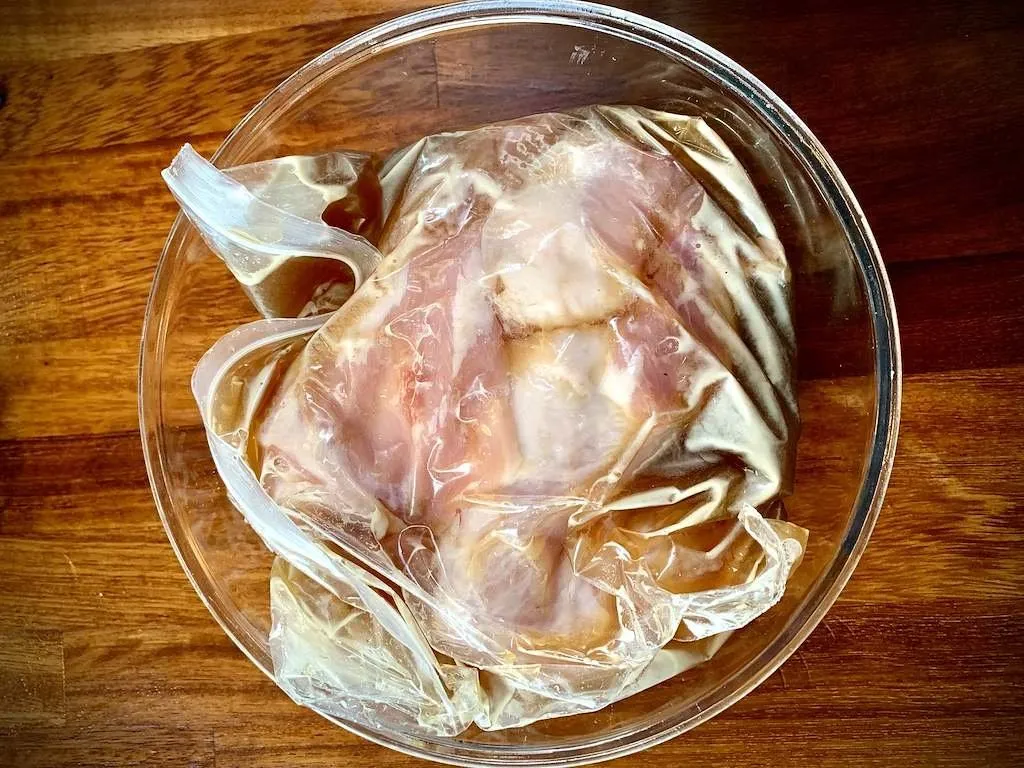
Put the chicken in a brining bag or a box with a lid. Pour the brine over and squeeze out the air so it’s covered all over.
A brining bag, food-grade plastic box, glass or stainless steel is fine. Not aluminium: salt eats into it.
Into the fridge

Keep it in the fridge at 5°C/41°F or colder. A whole chicken wants 24-48 hours.
When it’s done, take it out, pat it dry with kitchen roll and cook it the way you normally would.
For a dry brine, skip the water and rub the salt all over the meat. A 2 Kg pork shoulder (Pork, Shoulder, Dry brine: 1.75%) needs 35 g of salt and 24-48 hours in the fridge.
The calculator starts every recipe at my pick for salt and sugar. The sliders let you move either one between the mild and strong ends the world uses, and my pick stays marked so you can find your way back. On a wet brine you can also pick beer, cider, apple juice and more as your liquid, and the calculator counts the sugar and salt they bring, so you don’t add them twice.
The salt
Weigh it and most salts are much the same. Spoon it and they’re miles apart.
A level tablespoon of table salt weighs 18 g. A level tablespoon of Diamond Crystal kosher salt weighs 8.4 g. That’s less than half! And Morton kosher comes in at 14.4 g, so even the two kosher salts don’t match.
Follow a recipe’s spoons with a different salt and you could end up with more than double the salt it meant. That’s why the calculator works in grams.
| Salt | What it looks like | One level tablespoon | Brands |
|---|---|---|---|
| Fine sea salt | small, slightly uneven grains | 15 to 18 g | Saxa Fine Sea Salt (UK), Cornish Sea Salt Co Original (UK), supermarket own-brand fine sea salt (UK), Redmond Real Salt (fine) (USA) |
| Table salt | tiny, even cubes that pack tight | 18 g | Saxa Table Salt (UK), Cerebos (UK), supermarket own-brand table salt (UK), Morton Iodized Salt (USA) |
| Kosher salt: Diamond Crystal | light, hollow crystals that crush easily | 8 to 9 g | Diamond Crystal Kosher Salt (USA) |
| Kosher salt: Morton | flat, dense flakes | 14.4 g | Morton Coarse Kosher Salt (USA) |
| Flaky sea salt | big, thin, hollow pyramids | 7.5 to 18 g | Maldon Sea Salt Flakes (UK), Cornish Sea Salt Co Flakes (UK), Halen Môn Pure White Sea Salt (UK), Maldon Sea Salt Flakes (USA), Murray River Pink Salt Flakes (Australia) |
| Coarse rock or sea salt (food-grade, the grinder kind) | big, uneven lumps | 15 g (estimate) | — |
| Pickling or canning salt | fine, pure white grains | 18 g (estimate) | Morton Canning & Pickling Salt (USA) |
| Low-sodium salt | like fine table salt | not for brining | LoSalt (UK), So-Low (UK) |
For me, the best salt for brining is pure salt with nothing added. Fine sea salt and kosher are the easiest to use.
Flakes like Maldon are fine too, as long as you weigh them. Published weights for a spoonful of flakes run anywhere from 7.5 g to 18 g, so a spoon tells you nothing.
Table salt works. You’ll read that it’s no good for brining, but too much is made of that. It’s dense, that’s all, so weigh it.
Iodised is fine too: in tests, most people couldn’t taste the difference. If table salt turns your brine cloudy, that’s the anti-caking agent. It’s harmless.
What not to use:
- Low-sodium salt, like LoSalt or So-Low. Half or more of it is potassium. The calculator’s numbers are for ordinary salt, nobody’s tested it for home curing, and it isn’t safe for anyone told to watch their potassium, such as people with kidney problems or on some heart and blood-pressure pills. Want less salt? Slide it down instead.
- Garlic, celery or seasoned salts. There’s no telling how much of the weight is actually salt.
- Smoked salt and black salt. Lovely sprinkled on at the end, far too strong as the whole dose. Let the kamado do the smoking.
- Damp grey sea salt, like Celtic. It’s less salty by weight. Use a dry, plain salt.
- Road, ice-cream or water-softener salt. It isn’t food.
- Celery salt as a cure. It isn’t one.
- Curing salt as everyday salt. It’s for curing only, in the amount the calculator gives.
The science
Here’s what’s going on in the bag. Food scientists still argue over the finer details, but they agree on the order of things.
Water moves first
At the start, the brine is saltier than the juices inside the meat. So water moves first (that’s osmosis), and the meat starts to draw some of the brine in.
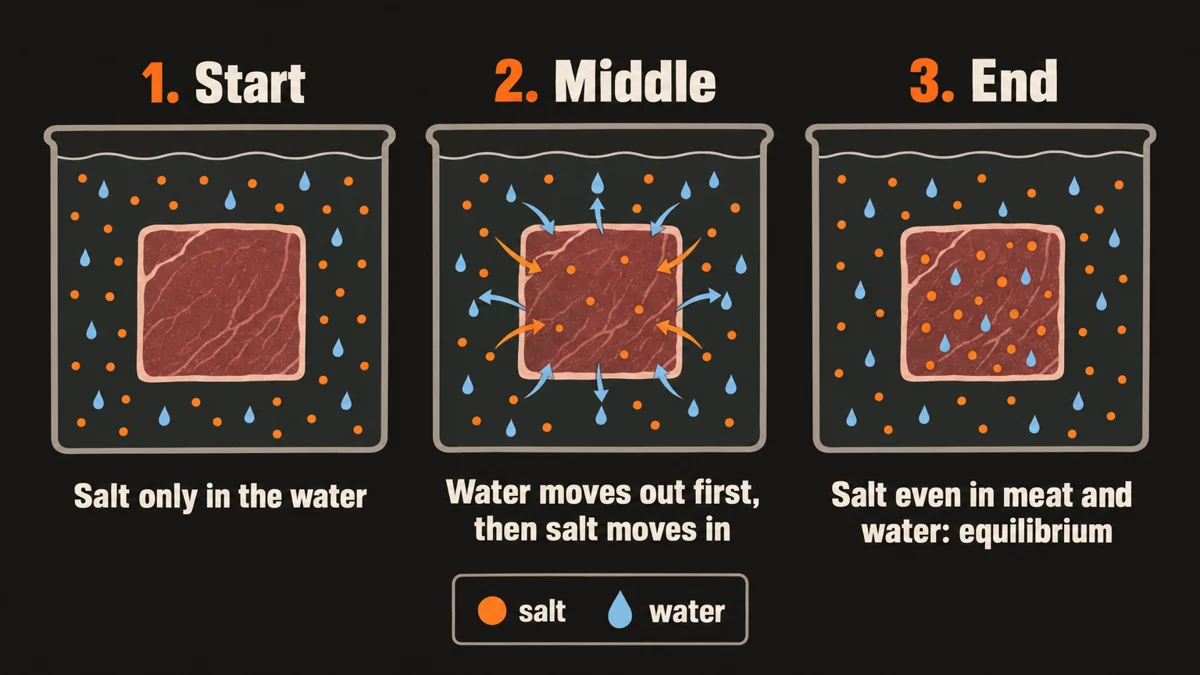
Then the salt spreads
Then the salt does the real work. Meat is full of tiny open gaps, and the salt makes its way in through the juices, from the outside in. Slowly it evens out until it’s the same all the way through, and the same as the water around it. That’s the equilibrium.
It’s also why thick pieces take so long. A piece twice as thick takes a lot more than twice as long.
Why it’s juicier
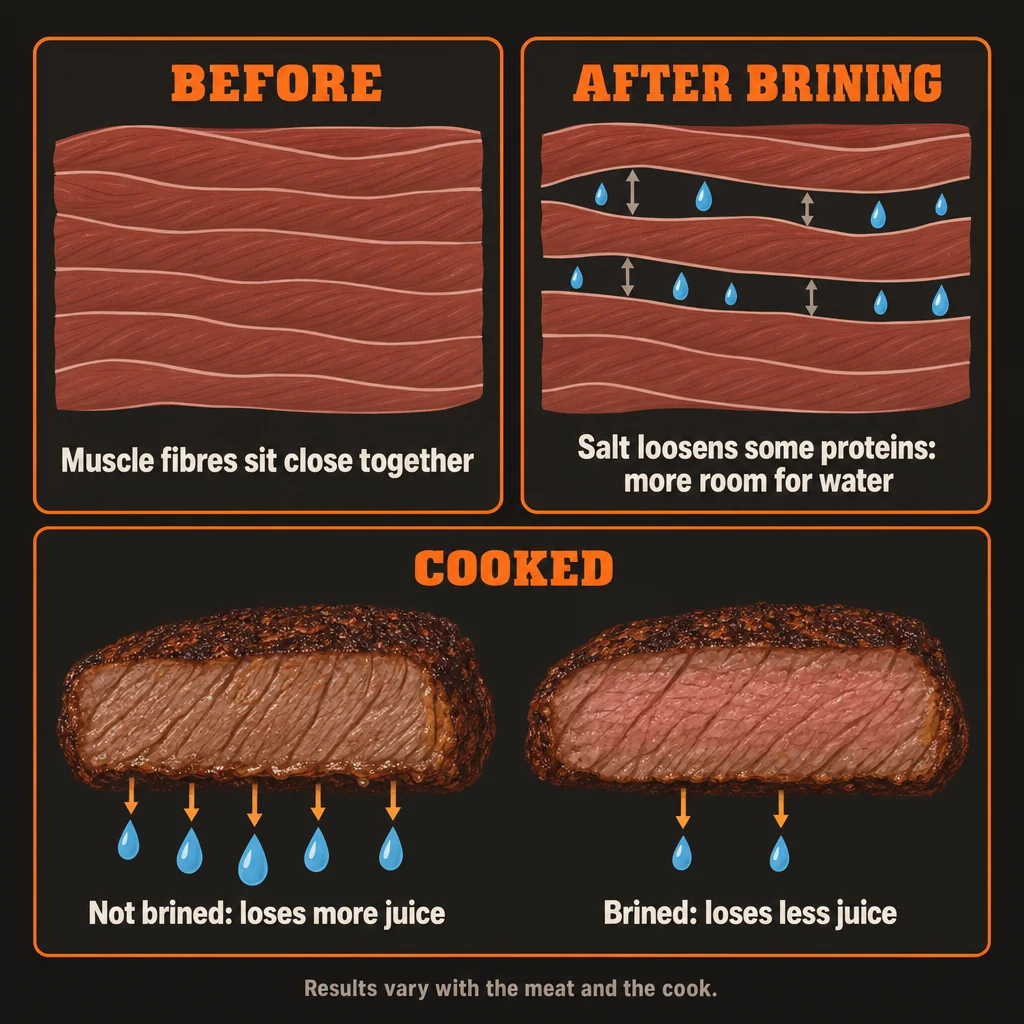
Salt loosens the proteins in the muscle. They unfold and hold on to more water, so less of it cooks out.
The loosened proteins can’t clump together as tightly when they cook either, so the meat seems more tender.
What it won’t do
Being honest, brining doesn’t always mean juicier. In one home test, a wet-brined brisket took on extra water in the brine, then came out of the oven weighing the same as the brisket it was up against.
And herbs and spices in a brine barely dissolve, so they don’t get far into the meat. The salt is what does the work.
How long it takes
Brines
There’s no tested formula for brining times by thickness. Salt slows down the further in it has to go, so everything on the menu has its own time. It can’t over-salt, so a little longer does no harm.
| What you’re brining | Method | Salt | Time |
|---|---|---|---|
| Chicken (whole) | Wet | 1.5% | 24-48 hours (about 24 hours per 1″/2.5cm) |
| Chicken (whole) | Dry | 1.25% | 12-24 hours |
| Chicken pieces | Wet | 1.5% | 4-8 hours |
| Chicken pieces | Dry | 1% | 4-24 hours |
| Turkey | Wet | 1.5% | up to 2 days |
| Turkey | Dry | 1.25% | 24-48 hours |
| Duck legs, for confit | Dry | 1.75% | 12-48 hours |
| Pork loin / chops | Wet | 1.5% | about 24 hours per 1″/2.5cm |
| Pork loin / chops | Dry | 1.25% | 12-48 hours |
| Pork shoulder | Wet | 1.5% | 24-72 hours |
| Pork shoulder | Dry | 1.75% | 24-48 hours |
| Beef brisket | Dry | 1.75% | 24-48 hours |
| Ribs | Dry | 1.25% | 2-12 hours |
| Fish fillets | Wet | 2% | 4-8 hours for trout and mackerel, 8-14 hours for a salmon fillet, 18-48 hours for a thick side |
| Fish fillets | Dry | 0.75% | 15 minutes to a few hours |
| Salmon, cured for smoking | Dry | 1.75% | 8-14 hours |
| Gravlax | Dry | 2.5% | 24-72 hours |
| Biltong | Dry cure | 2.2% | 10-24 hours, then dried |
Cures
For cures there’s a rule of thumb: 1 day for every 1/4″/6mm of thickness, plus 2 days, rounded up. Measure the thickest part, and the calculator works out the days for you. Don’t leave a wet cure past 3 weeks though: the water can spoil.
Jerky and smoked salmon are quicker and go by the hour. The calculator shows those times too.
Short answers
Rinsing
There’s no need. The salt was measured for the meat, so there’s nothing extra to wash off. Just pat it dry with kitchen roll. With a cure, a quick rinse under the cold tap is fine if you like, but it isn’t needed.
One thing never to do: wash raw chicken or turkey before it goes in. It just splashes germs round the sink.
Smoking after
Smoke it or cook it just as you normally would. Brining doesn’t cook anything, so cook it through. I take chicken and turkey to 74°C/165°F in the thickest part.
Reusing a brine
No. Raw meat has been sitting in it, and the salt was worked out for that piece of meat. Discard the brine and make fresh next time.
If it’s a turkey you’re doing, have a look at my How to Brine a Turkey guide as well. And if it’s jerky you’re after, try my Hickory Maple Beef Jerky.
Leave a comment below and I’ll get back to you.